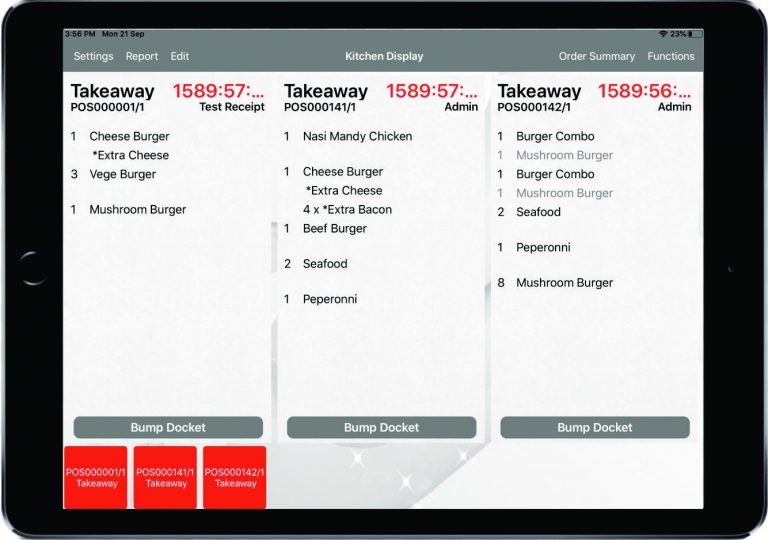
How do I stop kitchen tickets getting lost or misread?
Handwriting is the weak link, and the walk from till to pass is the second one. Close both: when a server rings an order up it is already on the kitchen’s screens — nothing to carry over, nothing scribbled for a line cook to decipher under pressure. That gap, between an order being taken and the kitchen knowing about it, is the whole reason a kitchen display exists.
Stations can watch the same stream in different ways. Whoever is plating doesn’t need what a prep cook working sides needs, so a screen can be set as order view, item view, prep view or a ready-for-service view, according to which station is reading it. Orders route to the terminal that will actually cook them — grill, pantry, fryer — so a ticket only appears where the work is. Colour coding keeps dine-in, takeaway and delivery apart at a glance, which a kitchen running all three at once needs more than it needs another column of text to read. A running summary of what’s been ordered, counted by item, lets the kitchen prep in batches instead of one ticket at a time.
Once a dish is marked done it leaves the active screen, and how long it took is kept. That is the part worth reading back later: which dishes run slow, which station is the bottleneck at eight on a Friday. Measured, not remembered.